 GayJustice.org
IN MEMORIAM · 22 JULY 2023
He Asked for Help: A Family Account of Reported Intimidation
Amsterdam, Netherlands · Family account · 22 July 2023
According to his relatives, a gay Dutch man sought protection after becoming a victim of fraud. His family is calling for an independent investigation into the conduct and decisions of police and justice authorities.
R. Grofstein and the relatives ask whether official actions and omissions increased his distress and request an independent investigation. This is a family account, not an established finding about the cause of his death. Suicide is complex and cannot be attributed to a single cause without careful evidence.
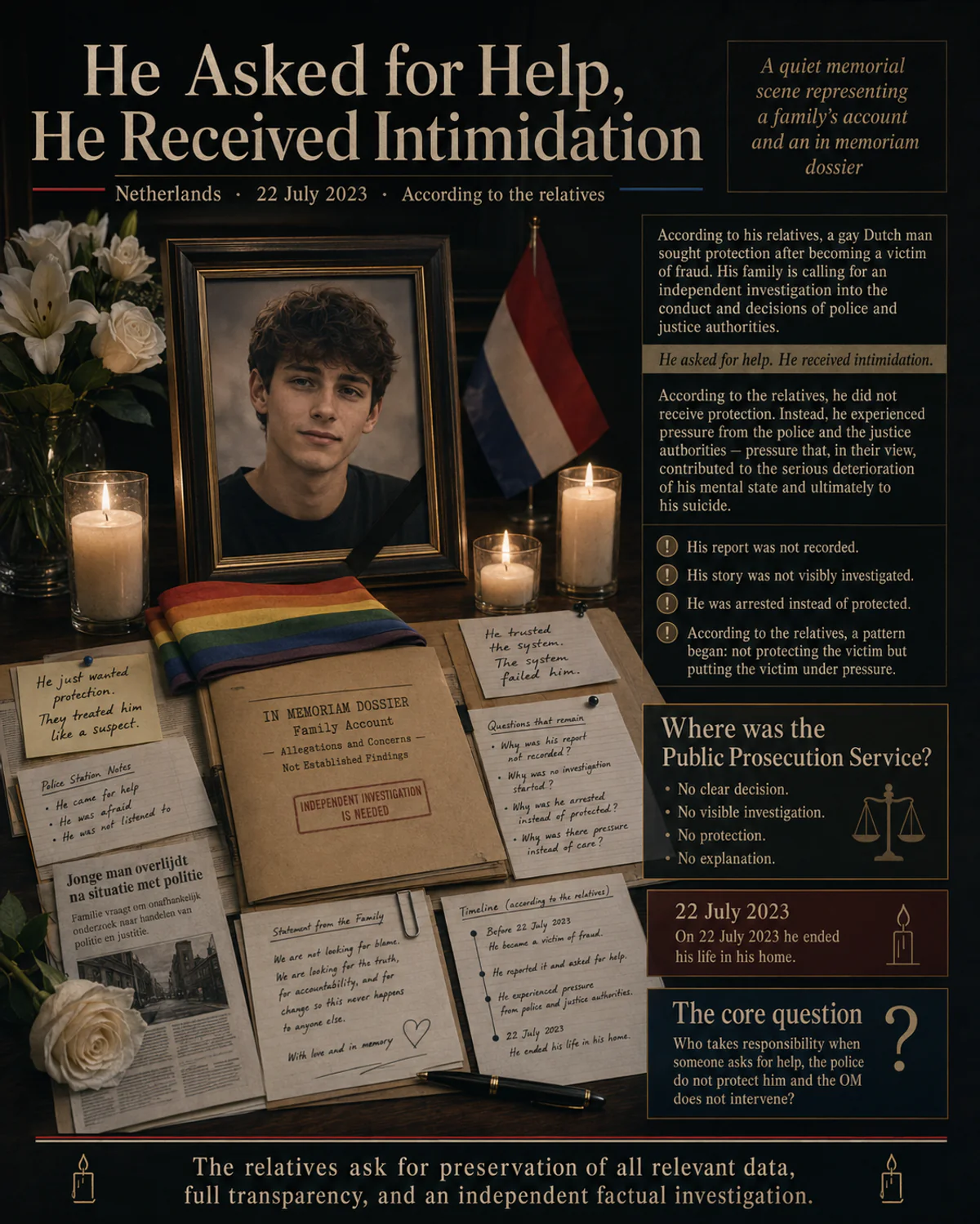
He asked for help. He received intimidation.
He reported to the police as a victim of fraud. He was financially exhausted, scared and desperate. He was not asking for a favour but for the protection that every citizen in a rule of law can count on.
According to his relatives, he did not receive that protection. They say that he instead experienced pressure during contacts with the police and justice authorities. They ask that those contacts be examined alongside the documented deterioration of his mental health; they do not present them as an independently established cause of his death.
His report was not recorded. His story was not visibly investigated. Instead of investigating the people he said had defrauded him, he was arrested himself. For him and his family it remained unclear on what concrete ground that happened.
Thus, according to the relatives, a pattern began: not protecting the victim but putting the victim under pressure.
After his arrest he was assigned a police officer who kept in contact with him. That contact should have brought calm, safety and clarity. According to the relatives it brought precisely fear. Especially in the evening he received messages he experienced as manipulative, intimidating and provocative.
He thought someone was finally listening to him. But he increasingly had the feeling that his words were being collected to be used against him. That the police were not looking for the truth about his fraud but for a reason to treat him as a problem again.
His relatives describe these police contacts as a source of severe distress for him. They say he felt controlled instead of helped, treated as a suspect instead of protected, and left alone instead of heard. During that period his mental health deteriorated, he experienced suicidal thoughts and he saw less and less of a way out.
Where was the Public Prosecution Service?
The police have powers. That is precisely why their conduct must be controlled. An important responsibility lies there with the Public Prosecution Service.
According to the relatives the OM should have asked why his report was not recorded. It should have assessed on what ground he was arrested. It should have checked whether the contact with the police officer was professional, necessary and de-escalating. It should have established whether a vulnerable citizen was being helped or put under further pressure.
According to the relatives this did not happen.
No clear decision.
No visible investigation.
No protection.
No explanation.
That indecisiveness was, in their view, not neutral. If the OM does not intervene, the police picture remains standing. The citizen is then left with a dossier he does not know, a suspicion he does not understand and a story no one seems willing to hear.
He was a victim of fraud but felt, according to his relatives, increasingly treated as a suspect. He was declared bankrupt, ran into further financial trouble and felt demonised by the police. His trust in the rule of law disappeared.
He said he felt completely without rights as a homosexual Dutchman in the country whose protection he expected. That was not a legal judgment but a cry of despair from someone who believed his fundamental rights were not being protected.
22 July 2023
On 22 July 2023 he ended his life in his home.
His relatives ask for independent investigation of the contacts he experienced as intimidating or manipulative, the protection offered to him and the response of the Public Prosecution Service. Suicide is complex and cannot, without careful evidence, be attributed to a single cause. That does not remove the need for an impartial review of relevant official actions and omissions.
The aftermath
Even after his death the family was left with proceedings, debts and costs. Two years later they are still involved in an expensive bankruptcy file. According to the relatives his mother received an invoice of around €124,000 in connection with the bankruptcy file around the commemoration day. They state they had insufficient insight into the work carried out, the progress and the result achieved.
A mother lost her son. And around the day she commemorated him, she received an invoice.
The core question
The core question remains: who takes responsibility when someone asks for help, the police do not protect him and the OM does not intervene?
The relatives are not asking for a judgment without investigation. They are asking for the preservation of all relevant data, full transparency, independent factual investigation and review of the actions and omissions of the police, the justice authorities and other involved authorities.
A story that must not be forgotten.
Editorial note: This dossier reflects the account of the relatives. Allegations that have not been independently established are identified as such. Suicide is complex and cannot be attributed to a single cause without careful investigation. If you are experiencing suicidal thoughts, contact 113 Zelfmoordpreventie (113.nl) or your general practitioner.